Cluster API (CAPI) is a Kubernetes sub-project that lets you manage the lifecycle of Kubernetes clusters using Kubernetes itself. You define a cluster in YAML, apply it to a management cluster, and CAPI controllers provision the infrastructure, bootstrap the nodes, and install Kubernetes. Upgrades, scaling, and deletion all work through the same declarative model.
The project is maintained by SIG Cluster Lifecycle and has been production-ready since version 1.0 in October 2021. The current release is v1.12 (January 2026), which introduced in-place updates and chained upgrades across multiple Kubernetes minor versions.
CAPI solves a real problem. But it introduces significant complexity that many organizations do not need. Understanding where CAPI fits and where simpler alternatives exist can save months of engineering effort.
How Cluster API works
CAPI follows the same controller pattern that Kubernetes uses internally. You define a desired state (a cluster with three control plane nodes and five workers running Kubernetes 1.31 on AWS), and controllers reconcile actual state with desired state continuously.
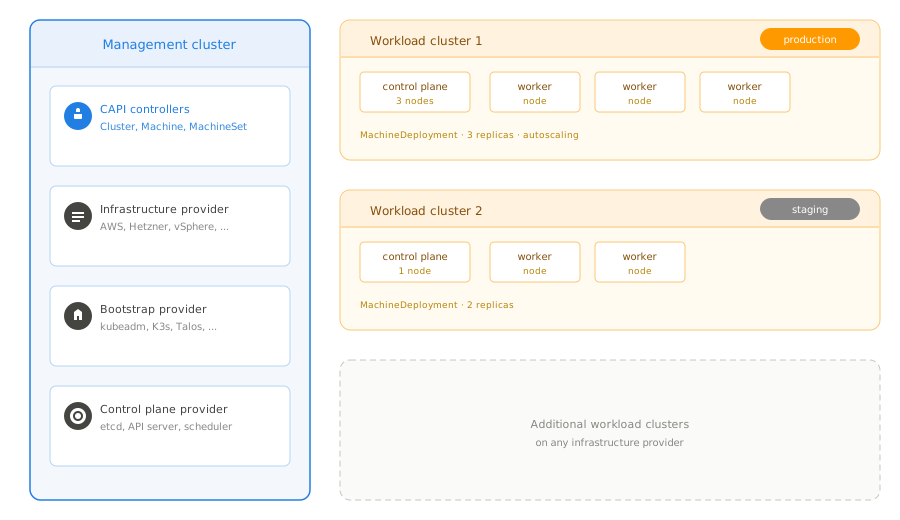
The architecture has four layers:
The management cluster is a Kubernetes cluster that runs CAPI controllers. It does not run application workloads. Its sole purpose is to provision and manage other clusters. This is the chicken-and-egg of CAPI: you need a Kubernetes cluster before you can create Kubernetes clusters.
Infrastructure providers are controllers that know how to create resources on a specific platform. The AWS provider creates EC2 instances, VPCs, and load balancers. The vSphere provider creates VMs. The Hetzner provider creates cloud servers. There are currently 37+ infrastructure providers covering major clouds, European providers, virtualization platforms, and bare metal.
Bootstrap providers turn a bare machine into a Kubernetes node. The default is kubeadm, but providers exist for K3s, RKE2, Talos, and MicroK8s.
Control plane providers manage the Kubernetes control plane components. They handle the sequencing of control plane upgrades, etcd membership, and certificate rotation.
A typical CAPI-managed cluster involves resources from all four layers working together. A cluster definition might look like this:
apiVersion: cluster.x-k8s.io/v1beta1
kind: Cluster
metadata:
  name: production
spec:
  clusterNetwork:
    pods:
      cidrBlocks: ["192.168.0.0/16"]
  controlPlaneRef:
    apiVersion: controlplane.cluster.x-k8s.io/v1beta1
    kind: KubeadmControlPlane
    name: production-control-plane
  infrastructureRef:
    apiVersion: infrastructure.cluster.x-k8s.io/v1beta1
    kind: AWSCluster
    name: production
This is a simplified excerpt. A complete cluster definition includes the infrastructure cluster, control plane, machine deployments, machine templates, and bootstrap configurations. Production setups typically span hundreds of lines of YAML across multiple resources.
What CAPI does well
CAPI’s core strength is providing a single, declarative API for cluster lifecycle management across any infrastructure. For organizations that need to create and manage clusters on AWS, Azure, vSphere, and bare metal using the same tooling and workflows, CAPI is the most mature option.
Consistency across providers. The cluster lifecycle (create, upgrade, scale, delete) follows the same API regardless of where the cluster runs. Platform teams can build automation and policies once and apply them everywhere.
GitOps compatibility. Because cluster state is defined in YAML, it fits naturally into version control and CI/CD pipelines. You can review, approve, and audit cluster changes the same way you review application code.
Automated upgrades. CAPI handles the sequencing of Kubernetes version upgrades, rolling out changes to control plane nodes first, then worker nodes, with configurable surge and drain strategies. The v1.12 release added chained upgrades that skip multiple minor versions in a single operation.
Extensibility. The provider model means CAPI can support any infrastructure platform. If a CAPI provider does not exist for your platform, you can write one.
Where CAPI gets hard
The operational reality of running CAPI in production is more complex than the declarative model suggests.
The management cluster is infrastructure you must operate. The management cluster needs its own high availability, monitoring, backup, and upgrades. If the management cluster goes down, you lose the ability to manage your workload clusters. Many organizations end up running the management cluster on a managed service (like EKS or GKE), which creates an ironic dependency on the very thing CAPI is meant to abstract away.
The learning curve is steep. Using CAPI effectively requires understanding the core CAPI concepts (Cluster, Machine, MachineDeployment, MachineSet, ClusterClass) and the provider-specific concepts for each infrastructure target. The AWS provider alone introduces AWSCluster, AWSMachine, AWSMachineTemplate, and AWSClusterControllerIdentity resources with their own schemas and behaviors.
Debugging is multi-layered. When a cluster fails to provision, the problem could be in the CAPI controllers, the infrastructure provider, the bootstrap provider, the control plane provider, or the underlying infrastructure. Diagnosing issues requires reading logs from multiple controllers and correlating events across resources in different namespaces.
Credential management at scale. Each infrastructure provider needs credentials with the right permissions. Managing these credentials across multiple providers, rotating them, and controlling access adds operational overhead that grows with fleet size.
Template sprawl. Without careful design, each combination of Kubernetes version, instance type, region, and configuration creates a new set of templates. ClusterClass (introduced in v1.1) addresses this with templating and composition, but adds its own abstraction layer to learn.

When CAPI makes sense
CAPI earns its complexity in specific scenarios where no simpler alternative exists.
You are building an internal Kubernetes platform. If your organization provides Kubernetes-as-a-service to internal teams, CAPI gives you a declarative API for cluster provisioning that integrates with your existing Kubernetes tooling, RBAC, and GitOps workflows.
You manage clusters across many infrastructure providers. If you have clusters on AWS, Azure, vSphere, and bare metal and need a single management plane for all of them, CAPI’s provider model is purpose-built for this. No other open-source tool covers as many infrastructure targets with a unified API.
You are a SaaS vendor provisioning clusters for customers. If your product involves creating dedicated Kubernetes clusters for each customer, CAPI provides the automation framework to do this at scale with consistent configuration and lifecycle management.
You need full control over every cluster component. CAPI gives you control over the operating system, Kubernetes version, CNI plugin, bootstrap method, and upgrade strategy. If your organization has strict requirements that preclude using managed services, CAPI provides the knobs.
When CAPI is not the right choice
For many organizations, CAPI introduces complexity that exceeds the problem it solves.
You run fewer than five clusters. The overhead of operating a management cluster, learning the CAPI API, and maintaining provider configurations is not justified for a small number of clusters. Manual provisioning with Terraform, or a managed service, is simpler and faster.
You use a single cloud provider. If all your clusters run on AWS, EKS is a simpler path than running CAPI with the AWS provider. The same applies to GKE on GCP and AKS on Azure. Managed Kubernetes services from your cloud provider handle the control plane, upgrades, and scaling without requiring a management cluster.
You do not have a dedicated platform team. CAPI requires deep Kubernetes expertise to operate. If your team’s primary focus is building applications rather than managing infrastructure, the operational overhead of CAPI will slow you down.
You want managed multi-cloud. CAPI manages clusters, but it does not manage them for you. You still handle control plane availability, node health, Kubernetes upgrades, and networking. If you want multi-cloud Kubernetes without the operational burden, a managed platform is the simpler path.
CAPI vs managed Kubernetes
The fundamental trade-off between CAPI and managed Kubernetes is control versus operational simplicity.
| CAPI | Managed Kubernetes | |
|---|---|---|
| Control plane | You manage (etcd, API server, HA, upgrades) | Provider manages |
| Multi-cloud | Native, single API across all providers | Typically single-cloud per service |
| Operational burden | High, requires dedicated platform team | Low, offloaded to provider |
| Getting started | Hours to days (management cluster + provider setup) | Minutes (API call or console) |
| Flexibility | Full control over every component | Constrained to provider options |
| Cost | Infrastructure + engineering time | Infrastructure + management fee |
| Best for | Platform teams, multi-cloud, internal K8s-as-a-service | Application teams, production workloads, operational simplicity |
Managed Kubernetes has evolved significantly since CAPI was first developed. Platforms like Cloudfleet Kubernetes Engine provide multi-cloud support in a single cluster spanning AWS, GCP, Hetzner, and on-premises infrastructure, with automated node provisioning, upgrades, and networking, without requiring a management cluster or CAPI expertise.
The question is not whether CAPI is a good project. It is. The question is whether your organization needs the flexibility CAPI provides, or whether you would rather spend your engineering time on applications instead of infrastructure management.
For organizations that need Kubernetes across multiple clouds and on-premises environments without operating the platform themselves, a managed multi-cloud approach eliminates the CAPI management cluster, the provider configurations, and the ongoing operational overhead, while delivering the same outcome: production Kubernetes wherever you need it.