The Google Distributed Cloud and Anthos alternative for hybrid Kubernetes
Cloudfleet is the Google Distributed Cloud and Anthos alternative for teams that want fully managed Kubernetes across clouds and on-premises. No GCP lock-in, no per-vCPU GKE Enterprise fees, no rebranding risk. Start with $230 (€200) in credit.
Google Distributed Cloud and GKE Enterprise vs. Cloudfleet at a glance
Features
What it does
GCP-centric fleet management, Google edge hardware, and on-premises software
Fully managed unified Kubernetes platform
On-premises hardware
Google-supplied hardware, or software-only clusters you operate
Your own servers, control plane managed by Cloudfleet
Multi-cloud support
GKE on AWS/Azure deprecated, attached clusters only
AWS, GCP, Azure, Hetzner, on-premises, and 12+ providers
Pricing
$6-24/vCPU/month + separate GCP support fees
Flat plans from $14/month (€12), Pro at $79/month (€69) all-inclusive
Disconnected operation
Separate air-gapped edition on Google-supplied hardware
Workloads keep running when the connection drops, on any Linux server
Product stability
Rebranded 3 times since 2019, features deprecated
Consistent platform with a stable roadmap
Vendor lock-in
Tied to GCP for monitoring, logging, and policy
Standard Kubernetes, provider-agnostic
Architecture
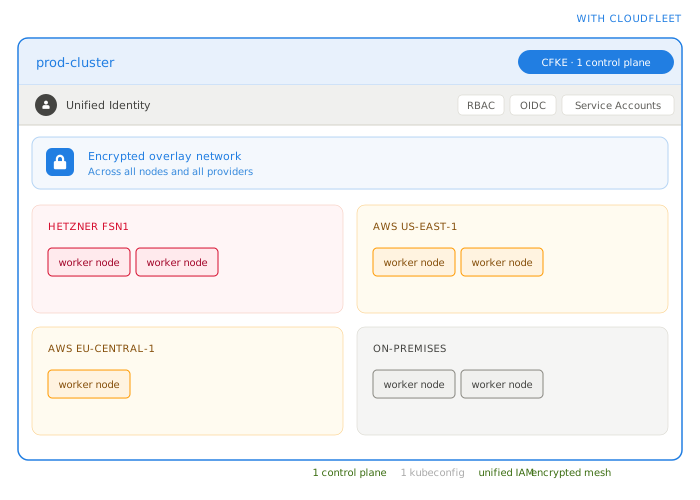
Your entire infrastructure footprint. One unified cluster.
Managed control plane
Cloudfleet is CNCF-conformant, allowing seamless migration of any conformant clusters while avoiding vendor lock-in.
Node autoprovisioning
Cloudfleet dynamically provisions compute capacity based on real-time demand.
On-premises tooling
Add on-premises nodes to your cluster with a single command and schedule pods across both on-premises and cloud nodes.
Global networking
Nodes securely connect via an encrypted network spanning multiple clouds and regions.
Why teams look for a Google Anthos alternative
Hybrid Kubernetes without GKE Enterprise lock-in
Google Anthos promised hybrid and multi-cloud Kubernetes. Since then, Anthos became GKE Enterprise, its on-premises clusters became Google Distributed Cloud (software only), and Google Distributed Cloud now also covers Google-supplied edge hardware and air-gapped editions. Through every rename, the platform stayed GCP-centric: fleet management, policy, and observability run through Google Cloud, pricing is per vCPU with separate support fees, and GKE on AWS and GKE on Azure were deprecated, leaving attached clusters as the only multi-cloud option.
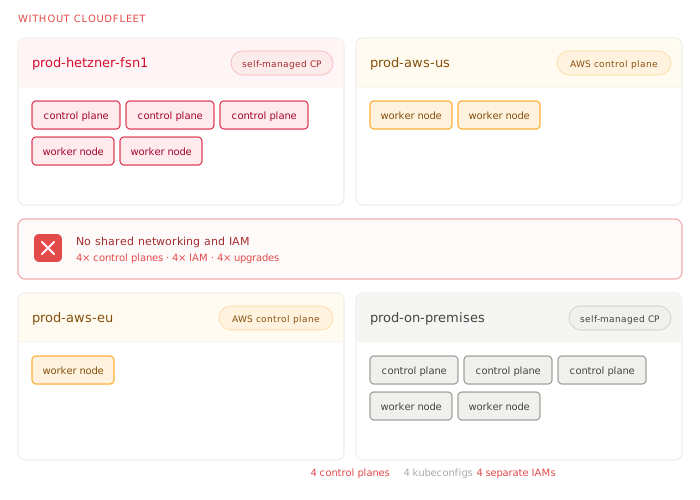
Cloudfleet takes a different approach. Instead of projecting one cloud provider’s management plane onto your infrastructure, Cloudfleet runs a single Kubernetes cluster that spans any combination of clouds and your own servers. You do not need a Google Cloud account, there are no per-vCPU platform fees, and there is no separate support plan to buy. Deploy across AWS, GCP, Azure, Hetzner, OVHcloud, and on-premises infrastructure with published, all-inclusive pricing.
Anthos pricing without the minimums
GKE Enterprise historically required a $10,000/month minimum per 100 vCPUs with a one-year commitment. Even with later pricing changes, per-vCPU charges ($6-24/vCPU/month) plus separate Google Cloud support fees (up to $15,000/month) add up fast. Cloudfleet’s Basic tier starts at $14/month (€12) with no cluster size limits. The Pro tier is $79/month (€69) with support included.
No GCP expertise required
GKE Enterprise ties monitoring, logging, policy, and identity to Google Cloud services, and operating it well takes deep GCP knowledge. Cloudfleet uses standard Kubernetes APIs across all providers. If your team knows Kubernetes, they can use Cloudfleet on day one.
Your hardware, not Google's
Google Distributed Cloud edge, the connected edition, runs on servers and racks that Google supplies. The software-only edition runs on your vSphere or bare metal, but your team operates the admin and user clusters. Cloudfleet nodes run on any Linux server you own, and Cloudfleet runs the control plane.
A stable product, not a rebranding target
From Cloud Services Platform to Anthos (2019) to GKE Enterprise (2023) to unified GKE (2025), with GKE on AWS and Azure deprecated along the way. Each change brings migration effort and business risk. Cloudfleet offers a consistent, expanding platform with no history of deprecating core capabilities.
Sovereignty and disconnected operation
Sovereign Kubernetes that keeps running when the connection drops
Teams evaluating Google Distributed Cloud want sovereignty and resilience at the edge. Cloudfleet delivers both: a European platform where your own keys protect your cluster data, and nodes that keep workloads running when the connection to the control plane drops. Your factories, stores, and edge sites stay online, on hardware you choose.
Workloads keep running offline
A lost uplink at a factory, store, or edge site does not stop the containers on its nodes. Services that run local replicas keep serving local traffic. Deployments, autoscaling, and other changes resume when the site reconnects.
European company, European control plane region
Cloudfleet is a European company headquartered in Berlin. Your application data never leaves the compute you choose: EU-native providers like Hetzner, OVHcloud, Scaleway, and Exoscale, or your own servers. Cluster metadata and its backups stay encrypted in the Frankfurt control plane region, keeping both data and metadata within European jurisdiction.
Your keys, your cluster data
On Enterprise, Confidential Control Plane encrypts every Kubernetes object with keys held in your own HSM or cloud KMS and runs the control plane on Confidential VMs. Without your key, neither Cloudfleet nor its infrastructure provider can decrypt stored cluster data.
No hardware from your platform vendor
Sovereignty includes choosing your own hardware and providers. Cloudfleet does not ship appliances or require certified racks. Use the servers you already own, in the data centers you already use.
Migration support
Moving off Anthos? We cover the overlap period while you migrate
You can run GKE Enterprise or Google Distributed Cloud and Cloudfleet side by side and move workloads one at a time. Through the Migration Acceleration Program, Cloudfleet offers up to $10,000 in credits toward cluster management fees, training, and professional services, and Cloudfleet Kubernetes architects help you plan the cutover. This is what changes for Anthos users.
Point Argo CD or Flux at the Git repositories that Config Sync uses today. Policy Controller is built on OPA Gatekeeper, so you can install Gatekeeper directly and keep your constraint templates.
Cloud Service Mesh
Cloud Service Mesh, formerly Anthos Service Mesh, is based on Istio, which runs on Cloudfleet. Many teams drop the mesh for cross-location traffic, because Cloudfleet connects all nodes over an encrypted WireGuard® overlay.
Clusters on bare metal and VMware
Servers and VMs behind Google Distributed Cloud (software only) clusters join Cloudfleet with one command. There are no admin clusters or admin workstations to keep.
Google Cloud APIs
Workloads that call Google Cloud APIs use Workload Identity Federation, with no service account keys stored in the cluster. You can also keep nodes on GCP inside the same Cloudfleet cluster.
Get started
Switch from Anthos to Cloudfleet
Create a Kubernetes cluster
Start with $230 (€200) in credit when you sign up. The Basic plan starts at $14/month (€12) with no cluster size limits.
Plan your move from GKE Enterprise or Google Distributed Cloud with a Cloudfleet Kubernetes architect, and ask about Migration Acceleration Program credits.
Google Distributed Cloud and Anthos alternative: frequently asked questions
Google renamed Anthos to GKE Enterprise in 2023 and folded its features into GKE in 2025. Anthos clusters on bare metal and VMware are now called Google Distributed Cloud (software only). Searches for Google Anthos and Google Distributed Cloud therefore often describe the same products. Read what happened to Google Anthos for the full timeline.
Google Distributed Cloud is Google’s family of on-premises and edge offerings. It includes a connected edition on Google-supplied hardware, often called Google Distributed Cloud edge, an air-gapped edition for fully disconnected sites, and a software-only edition for your own vSphere or bare metal servers. Cloudfleet gives you the same hybrid reach on hardware you choose, with one managed control plane and published pricing.
GKE Enterprise charges $6-24/vCPU/month, with separate Google Cloud support fees that can reach $15,000/month. Google Distributed Cloud hardware editions are priced through Google sales. Cloudfleet’s Basic tier starts at $14/month (€12) with no cluster size limits and no minimum commitment. The Pro tier is $79/month (€69) with support and a 99.95% SLA, and every new account gets $230 (€200) in credit.
Yes. Edge sites keep running their workloads when the connection to the control plane drops, and the cluster picks up changes as soon as it returns. Add any Linux server at a factory, store, or remote site with one command, and manage every site from one cluster. Read what happens when the control plane connection drops for how to design site workloads.
Yes. Cloudfleet runs CNCF-conformant Kubernetes, so your existing workloads, Helm charts, and manifests work without modification. Config Sync repositories move to Argo CD or Flux, Policy Controller constraints move to OPA Gatekeeper, and on-premises servers join as self-managed nodes. No GCP-specific APIs or tooling are required on Cloudfleet.
No. Cloudfleet operates the control plane for you, so you never need a GCP account, GCP fleet management, or GCP observability services. Your nodes can run on AWS, GCP, Azure, Hetzner, OVHcloud, Scaleway, Exoscale, and on-premises infrastructure.
Cloudfleet is a European company headquartered in Berlin. Cloudfleet never holds your application data: it stays on the compute you choose, such as EU-native providers or your own servers. Cluster metadata and backups stay encrypted in the Frankfurt control plane region, so both data and metadata remain within European jurisdiction. On Enterprise, Confidential Control Plane encrypts cluster data with keys held in your own HSM or KMS, so no one without your key can decrypt stored cluster data.
Yes. Any Linux server joins a Cloudfleet cluster with a single CLI command, so you are not tied to Google-supplied hardware. Each site keeps running its Pods during connection loss, and one cluster can span all your sites and clouds.
Cloudfleet seamlessly extends your cluster anywhere, turning any hardware - even in your office or home - into a modern enterprise cluster.
Jules Huls
Information Security Expert
Using Cloudfleet together with Hetzner allowed us to bring up a managed Kubernetes cluster just as quick as with any US-based hyper-scaler, but with the benefit of being EU hosted which is very valuable in today's times.
Martin Schulze
CEO & Founder
By combining our standardized configurations with the powerful automation features of the Cloudfleet platform, we've built a development workflow that is fast, secure, and incredibly efficient.
Onur Solmaz
VP of Engineering and Research
Perfect balance between flexibility and managed service - and the support is outstanding.
Daniel Costa
Sales Engineer
We deploy to customer infrastructure without changing how we build or manage Kubernetes.
Julian Becker
Principal DevOps Engineer
It is easy to build a multi-cloud setup without getting locked into any single provider.
Carlos Mendes
Infrastructure Architect
It is easy to build a multi-cloud setup without vendor lock-in.
Luca Meyer
Principal DevOps Engineer
Cloudfleet lets us scale our game servers across multiple providers - reliably and affordably.
Max Keller
Senior DevOps Engineer
Cloudfleet not only cut our infrastructure costs - it saved us hours of work by taking cluster management off our plate.
Richard Callahan
Engineering Manager
Why Cloudfleet
Designed for modern cloud operations.
Hybrid-cloud by design
Run Kubernetes consistently across public cloud, private infrastructure, and on-prem environments, with a single control plane and unified operational model.
Operational simplicity
Operate, scale, and migrate Kubernetes clusters across environments using a consistent, opinionated platform that reduces operational overhead.
Predictable costs
Transparent pricing and infrastructure control help you avoid hyperscaler lock-in, hidden fees, and unexpected cost growth as your workloads scale.
No vendor lock-in
Retain full portability of your clusters, workloads, and tooling by running standard Kubernetes without proprietary extensions or forced dependencies.
Production-grade support
Designed for production workloads, with operational tooling, escalation paths, and support processes built to meet enterprise reliability requirements.
Enterprise-ready security
Secure by default, with isolation, encryption, and access controls designed to meet the requirements of regulated and security-conscious organizations.
Try Cloudfleet with €200 in credit
Create a managed Kubernetes cluster in minutes. Every new account gets €200 in credit, so you can explore the full platform with no charge until it's used or expires.