The OpenShift alternative for hybrid Kubernetes
Fully managed Kubernetes across clouds and on-premises. No subscription lock-in, no 300% renewal surprises, no dedicated platform team required. Start free today.

Fully managed Kubernetes across clouds and on-premises. No subscription lock-in, no 300% renewal surprises, no dedicated platform team required. Start free today.












| Features | |  |
|---|---|---|
What it does | Self-managed platform-as-a-service on Kubernetes | Fully managed unified Kubernetes platform |
Pricing | Per-core subscriptions with multi-year lock-in, $92K-$280K/yr typical | Pay-as-you-go, no commitments, free tier available |
Operational burden | Dedicated platform team, 100+ components to manage | Fully managed, no platform team needed |
Kubernetes compatibility | Proprietary abstractions (SCCs, DeploymentConfigs) | Standard CNCF-conformant Kubernetes |
Multi-cloud networking | Separate clusters per cloud, manual mesh setup | Encrypted overlay network across all environments |
Data sovereignty | US CLOUD Act applies (IBM/Red Hat) | European company, EU-native providers supported |
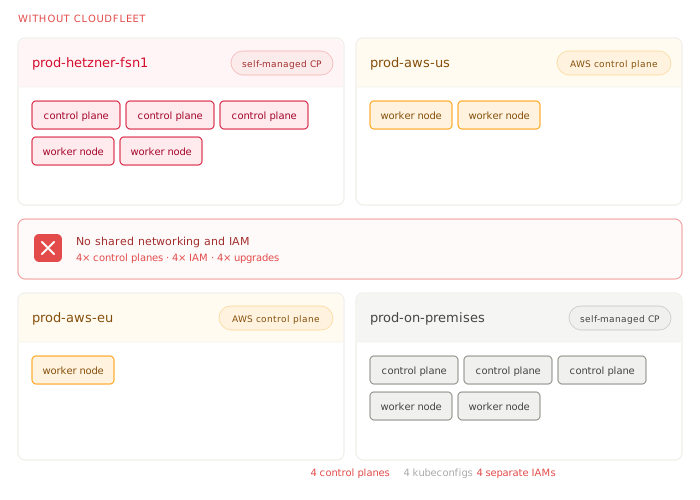
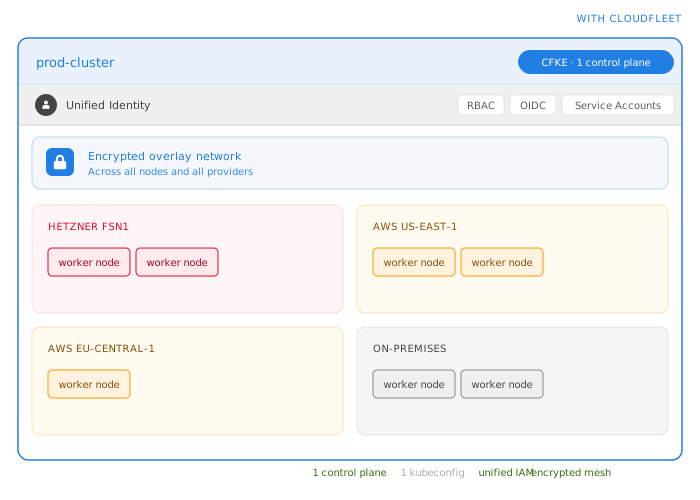

Cloudfleet is CNCF-conformant, allowing seamless migration of any conformant clusters while avoiding vendor lock-in.
Cloudfleet dynamically provisions compute capacity based on real-time demand.
Add on-premises nodes to your cluster with a single command and schedule pods across both on-premises and cloud nodes.
Nodes securely connect via an encrypted network spanning multiple clouds and regions.
Red Hat OpenShift is a powerful platform, but that power comes at a cost. Per-core licensing fees that can reach $92,000-$280,000/year for a mid-size deployment. Dedicated platform teams to manage upgrades across 100+ bundled components. Proprietary abstractions like Security Context Constraints that do not exist in standard Kubernetes. And since the switch from per-socket to per-core pricing, organizations report 300-500% increases at renewal, with licensing costs that can exceed the underlying hardware.
Cloudfleet delivers enterprise-grade hybrid Kubernetes without the complexity or cost. A single unified cluster spans multiple clouds and on-premises locations. The control plane, node provisioning, networking, upgrades, and scaling are all fully managed. Standard Kubernetes APIs mean your team’s existing skills transfer directly. Transparent pay-as-you-go pricing starts free and scales predictably without per-core surcharges or mandatory multi-year commitments.
OpenShift’s per-core subscription model creates a “success penalty” where upgrading to more powerful hardware multiplies licensing costs even with the same node count. Organizations report 300-500% price increases at renewal as per-socket discounts are phased out. Cloudfleet uses transparent pay-as-you-go pricing with no multi-year commitments or opaque subscription tiers. The Basic tier is free for up to 24 vCPUs. The Pro tier is $79/month with support included.
OpenShift self-managed deployments require dedicated platform teams for installation, upgrades, certificate management, and maintenance of 100+ bundled components. Managed variants (ROSA, ARO) reduce overhead but tie you to a single cloud and add dual billing. Cloudfleet manages everything end-to-end: control plane, node provisioning, networking, security patching, and Kubernetes upgrades.
OpenShift adds proprietary concepts like Security Context Constraints, DeploymentConfigs, and Routes that create a learning curve and migration difficulty. Cloudfleet runs CNCF-conformant Kubernetes with standard APIs. Your existing manifests, Helm charts, and tooling work without modification. No vendor-specific abstractions to learn or maintain.
Red Hat is owned by IBM, a US company subject to the CLOUD Act. Cloudfleet is European-headquartered and supports running workloads exclusively on EU-native infrastructure providers like Hetzner, OVHcloud, Scaleway, and Exoscale, keeping both data and metadata within European jurisdiction.
Cloudfleet seamlessly extends your cluster anywhere, turning any hardware - even in your office or home - into a modern enterprise cluster.

Using Cloudfleet together with Hetzner allowed us to bring up a managed Kubernetes cluster just as quick as with any US-based hyper-scaler, but with the benefit of being EU hosted which is very valuable in today's times.

By combining our standardized configurations with the powerful automation features of the Cloudfleet platform, we've built a development workflow that is fast, secure, and incredibly efficient.

Perfect balance between flexibility and managed service - and the support is outstanding.

We deploy to customer infrastructure without changing how we build or manage Kubernetes.

It is easy to build a multi-cloud setup without getting locked into any single provider.

It is easy to build a multi-cloud setup without vendor lock-in.

Cloudfleet lets us scale our game servers across multiple providers - reliably and affordably.

Cloudfleet not only cut our infrastructure costs - it saved us hours of work by taking cluster management off our plate.

Run Kubernetes consistently across public cloud, private infrastructure, and on-prem environments, with a single control plane and unified operational model.

Operate, scale, and migrate Kubernetes clusters across environments using a consistent, opinionated platform that reduces operational overhead.

Transparent pricing and infrastructure control help you avoid hyperscaler lock-in, hidden fees, and unexpected cost growth as your workloads scale.

Retain full portability of your clusters, workloads, and tooling by running standard Kubernetes without proprietary extensions or forced dependencies.

Designed for production workloads, with operational tooling, escalation paths, and support processes built to meet enterprise reliability requirements.
Secure by default, with isolation, encryption, and access controls designed to meet the requirements of regulated and security-conscious organizations.
Create your free Cloudfleet Kubernetes cluster in minutes - no setup hassle, no cost. Get started instantly with the always-free Basic plan.