Managed Kubernetes on Proxmox VE

Turn your Proxmox VE servers into a production-ready Kubernetes cluster with Cloudfleet. Fully managed control plane, automated node provisioning, and no self-managed k3s or kubeadm to maintain. Start for free with €200 (~$230) in credit.


/images/providers/proxmox.png
Quick comparison

Self-managed Kubernetes on Proxmox vs. Cloudfleet

Features/images/comparison/proxmox.svg/images/logo_text_transparent.png

Control plane

You build, run, and recover it yourself

Fully managed and highly available

Node provisioning

Manual bootstrapping and join steps

Automated via Terraform and cloud-init

Upgrades and patching

Your responsibility, with downtime risk

Automated, zero-downtime upgrades

Container registry

Run your own (Harbor, etc.)

Managed registry included

Hybrid and cloud bursting

Separate clusters or complex federation

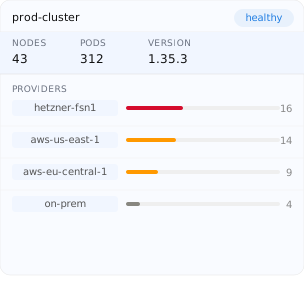
One cluster spans Proxmox and 12+ clouds

Cost to start

Free tools, but high operational cost

From €12/mo ($14) plus €200 credit, Pro €69/mo ($79)
/images/stack/cloudfleet-kubernetes-engine.svg
Cloudfleet Kubernetes Engine

Managed Kubernetes on your Proxmox hardware

Cloudfleet Kubernetes Engine (CFKE) runs a fully managed, CNCF-conformant control plane and connects it to virtual machines on your own Proxmox VE servers. There is nothing to install or upgrade on your side: Cloudfleet handles the API servers, etcd, certificates, security patches, and Kubernetes version upgrades. Provision nodes with Terraform and cloud-init, and each VM registers itself with your cluster automatically in two to three minutes.

/images/stack/cloudfleet-container-registry.svg
Cloudfleet Container Registry

Managed artifact registry included

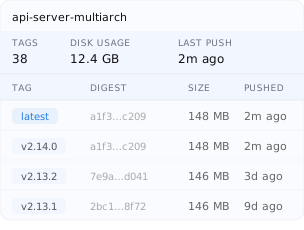
Proxmox VE is a virtualization platform, not a container ecosystem, so it ships no image registry. Cloudfleet Container Registry (CFCR) fills that gap with a fully managed, OCI-compliant registry included with every organization. Store, share, and pull container images without running Harbor or a self-hosted registry next to your cluster, backed by Cloudfleet's highly available platform.

/images/stack/cloudfleet-charts-marketplace.svg
Charts Marketplace

Managed services on-premises

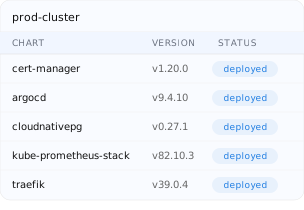
No managed databases behind your firewall? Deploy production-ready operators and Helm charts straight onto your Proxmox-backed clusters through Cloudfleet Charts Marketplace (preview). PostgreSQL, MongoDB, Redis, observability tools, ingress controllers, and more, all pre-configured. You keep full control of your infrastructure while getting the convenience of managed services.

Proxmox VE & Kubernetes

Run Kubernetes on Proxmox VE without the operational burden

Proxmox VE gives you a powerful, open-source foundation for running virtual machines on your own hardware, and adoption has surged as teams move away from VMware after the Broadcom acquisition and its licensing changes. But Proxmox does not orchestrate containers. Getting to production Kubernetes still means standing up and maintaining k3s, kubeadm, or Talos yourself, and owning every upgrade, patch, and control plane failure.

Cloudfleet removes that work. It delivers a fully managed Kubernetes control plane and turns your Proxmox VMs into cluster nodes that provision, join, and heal automatically. Your data and workloads stay on your hardware, while the operational complexity moves to Cloudfleet. When you need more capacity than your data center can provide, add nodes from AWS, GCP, Azure, or Hetzner to the same cluster and burst into the cloud without re-architecting anything.

Fully managed control plane

Skip self-managed Kubernetes on Proxmox with k3s, kubeadm, or Talos. Cloudfleet runs and operates the control plane for you, including API servers, the persistence layer, security patches, and zero-downtime version upgrades. If your team knows Kubernetes, you can run production clusters on Proxmox in minutes, not weeks.

Automated node provisioning with Terraform

Add Proxmox VMs to your cluster with the Cloudfleet Terraform provider and cloud-init. Clone a template, apply, and each VM installs the node components and registers with your cluster on boot. Scaling up is a single variable change, and nodes join in two to three minutes with no manual bootstrapping.

Burst from on-premises into the public cloud

Keep steady-state workloads on your cost-effective Proxmox hardware and expand into AWS, GCP, Azure, Hetzner, and more when demand spikes. A single Cloudfleet cluster spans on-premises and cloud through an encrypted overlay network, so you handle peaks without over-provisioning your data center.

Your hardware, your data sovereignty

Workloads and data run on servers you own and control, with no hyperscaler lock-in and no CLOUD Act exposure. Cloudfleet is European-headquartered, and nodes only need outbound HTTPS to reach the control plane, so nothing is exposed to the public internet.

Terraform example

Join a Proxmox VM to your cluster

Cloudfleet renders a cloud-init join file for the node. You upload it to the Proxmox snippets store, and Proxmox injects it into the VM on boot. The node then installs Kubernetes components and registers with your cluster automatically.

Kubernetes manifest example

Pin a workload to your Proxmox nodes

Use standard Kubernetes labels to schedule sensitive or stateful workloads onto your on-premises Proxmox nodes, while letting other pods burst into the cloud.

# Cloudfleet renders the cloud-init join file (.rendered)
resource "cloudfleet_cfke_node_join_information" "proxmox" {
  cluster_id    = var.cfke_cluster_id
  region        = "on-premises"
  zone          = "proxmox"

  node_labels = {
    "cfke.io/provider" = "proxmox"
  }
}

# Upload the rendered file to the Proxmox snippets store
resource "null_resource" "cloud_init" {
  triggers = { content = cloudfleet_cfke_node_join_information.proxmox.rendered }

  connection {
    type        = "ssh"
    host        = var.proxmox_ssh_host
    user        = "root"
    private_key = file(var.proxmox_ssh_private_key)
  }

  provisioner "file" {
    content     = cloudfleet_cfke_node_join_information.proxmox.rendered
    destination = "/var/lib/vz/snippets/${var.cfke_cluster_id}.yaml"
  }
}

resource "proxmox_vm_qemu" "cfke_node" {
  depends_on  = [null_resource.cloud_init]
  name        = "cfke-node-1"
  target_node = var.proxmox_target_node
  clone       = "ubuntu-cloudinit"
  agent       = 1

  cpu {
    cores   = 4
    sockets = 1
  }
  memory = 8192

  # Inject the uploaded cloud-init join file
  cicustom  = "vendor=local:snippets/${var.cfke_cluster_id}.yaml"
  ipconfig0 = "ip=dhcp,ip6=auto"

  # disks and network blocks omitted for brevity, see docs
}
apiVersion: v1
kind: Pod
metadata:
  name: on-prem-app
spec:
  nodeSelector:
    topology.kubernetes.io/region: on-premises
    cfke.io/provider: proxmox
  containers:
  - name: on-prem-app
    image: nginx
    resources:
      requests:
        memory: "256Mi"
        cpu: "500m"
Terraform example

Join a Proxmox VM to your cluster

Cloudfleet renders a cloud-init join file for the node. You upload it to the Proxmox snippets store, and Proxmox injects it into the VM on boot. The node then installs Kubernetes components and registers with your cluster automatically.

Kubernetes manifest example

Pin a workload to your Proxmox nodes

Use standard Kubernetes labels to schedule sensitive or stateful workloads onto your on-premises Proxmox nodes, while letting other pods burst into the cloud.

Cloudfleet + Proxmox VE

Why Proxmox and Cloudfleet are the perfect match

Proxmox VE delivers enterprise virtualization on your own hardware at a fraction of proprietary licensing costs. Cloudfleet adds the missing layer: a hyperscaler-grade managed Kubernetes experience on top of it, so you get cloud-native operations without giving up control of your infrastructure.

Open-source foundation, no lock-in

Proxmox VE is fully open source with no per-socket licensing, and Cloudfleet runs certified upstream Kubernetes. Your stack stays portable and standards-based from the hypervisor up.

A clear path off VMware

Teams migrating from vSphere to Proxmox after Broadcom’s licensing changes get a managed Kubernetes story on day one, without trading one vendor lock-in for another.

Hybrid by design

Combine Proxmox nodes with public cloud instances in one cluster. Run baseline load on-premises for cost and control, and scale into the cloud on demand, all from a single Kubernetes API.

Get started

Run managed Kubernetes on Proxmox VE

Create a Kubernetes cluster

Start with €200 ($230) in credit when you sign up. The Basic plan starts at €12/month ($14) with no cluster size limits.

Talk to our team

Planning a VMware-to-Proxmox migration or a hybrid setup? Our team can help with architecture review and onboarding.
FAQ

Managed Kubernetes on Proxmox: frequently asked questions

Cloudfleet runs a fully managed Kubernetes control plane and connects it to virtual machines on your Proxmox VE servers. You provision the VMs with the Cloudfleet Terraform provider and cloud-init, and each VM installs the node components and registers with your cluster automatically on boot, typically in two to three minutes. You never install, upgrade, or operate any control plane components yourself.

With self-managed Kubernetes on Proxmox using k3s, kubeadm, or Talos, you are responsible for building the control plane, upgrading Kubernetes, rotating certificates, configuring networking, and recovering from failures. Cloudfleet handles all of this. You get a production-ready, CNCF-conformant cluster with automated node provisioning, security patching, and zero-downtime upgrades, without maintaining any cluster tooling.

Yes. A single Cloudfleet cluster can span your Proxmox VE servers and providers like AWS, GCP, Azure, and Hetzner at the same time. All nodes connect through an encrypted overlay network, so you can keep baseline workloads on-premises and burst into the cloud when demand spikes, without running separate clusters or federation.

You need a Proxmox VE server with API access and an API token, SSH access to the host, and the snippets content type enabled on your storage for cloud-init files. Nodes run Ubuntu 24.04, which you prepare once as a cloud-init template. Nodes only require outbound HTTPS on port 443 to reach the control plane, plus UDP 41641 for the WireGuard tunnel between nodes. No inbound access from the internet is needed.

The Cloudfleet Basic plan starts at €12/month ($14) and includes 8 vCPUs, with a per-vCPU management fee above that and no cluster size limits. Every new account starts with €200 ($230) in credit, so you can begin for free. The Pro tier is €69/month (~$79) with support included. Because the nodes are your own Proxmox VMs, Cloudfleet does not charge for the underlying infrastructure.

Yes. Many teams are moving from VMware vSphere to Proxmox VE after Broadcom’s licensing changes, and Cloudfleet gives that new environment a managed Kubernetes layer immediately. You get cloud-native orchestration on top of Proxmox without adopting a heavyweight platform or a new proprietary vendor, and you can extend the same cluster into public clouds when needed.

Yes. Cloudfleet runs a CNCF-conformant Kubernetes distribution, so workloads from any conformant cluster migrate using standard tooling. Deploy your existing manifests, Helm charts, and CI/CD pipelines without modification.

Proxmox Virtual Environment is a fully open-source platform for enterprise virtualization, combining the KVM hypervisor, LXC containers, software-defined storage, and networking behind a single web interface and API. It is a strong foundation for on-premises infrastructure, but it does not orchestrate application containers. Running Kubernetes on Proxmox pairs its cost-effective virtualization with cloud-native scaling, self-healing, and automation, and Cloudfleet delivers that Kubernetes layer as a managed service.

Learn more about Kubernetes on Proxmox VE and Cloudfleet

Documentation

Use cases

Blog and tutorials

Security built-in.

Access control & governance

Fine-grained role-based access control (RBAC) with organization and project scopes, least-privilege permissions, and comprehensive audit trails for all user actions.

User
User
Kubernetes
User
User

Identity federation

Enterprise Single Sign-On (SSO) via SAML and OIDC, integrating with Okta, Microsoft Entra ID, Google Workspace, and other compatible identity providers.

Cloudfleet Microsoft Entra integration
Cloudfleet Okta integration
Cloudfleet Google Workspaces integration

Enterprise-grade security

Governance, centralized audit logging, and compliance readiness aligned with SOC 2 and ISO 27001 standards (certifications in progress).

Cloudfleet GDPR badge
GDPR
COMPLIANT
Cloudfleet CCPA badge
CCPA
COMPLIANT

Enterprise support you deserve.

Built to support large-scale, mission-critical deployments with dedicated teams, proven processes, and clear operational commitments.

Professional services

Expert-led architecture, deployment, and migration services to help you design, roll out, and scale Cloudfleet across complex environments.

Customer success team

A dedicated customer success team guiding onboarding, adoption, and long-term success, with access to best practices and operational guidance.

Technical account support

24/7 access to experienced engineers via defined support channels, with clear escalation paths for critical incidents.

Service Level Agreements

Clearly defined Service Level Agreements (SLAs) covering availability, response times, and incident handling for mission-critical workloads.

Case studies

Powering critical infrastructure for engineering teams worldwide.

Cloudfleet seamlessly extends your cluster anywhere, turning any hardware - even in your office or home - into a modern enterprise cluster.

Jules Huls, Information Security Expert
Jules Huls
Information Security Expert

Using Cloudfleet together with Hetzner allowed us to bring up a managed Kubernetes cluster just as quick as with any US-based hyper-scaler, but with the benefit of being EU hosted which is very valuable in today's times.

Martin Schulze, CEO & Founder
Martin Schulze
CEO & Founder

By combining our standardized configurations with the powerful automation features of the Cloudfleet platform, we've built a development workflow that is fast, secure, and incredibly efficient.

Onur Solmaz, VP of Engineering and Research
Onur Solmaz
VP of Engineering and Research

Perfect balance between flexibility and managed service - and the support is outstanding.

Daniel Costa, Sales Engineer
Daniel Costa
Sales Engineer

We deploy to customer infrastructure without changing how we build or manage Kubernetes.

Julian Becker, Principal DevOps Engineer
Julian Becker
Principal DevOps Engineer

It is easy to build a multi-cloud setup without getting locked into any single provider.

Carlos Mendes, Infrastructure Architect
Carlos Mendes
Infrastructure Architect

It is easy to build a multi-cloud setup without vendor lock-in.

Luca Meyer, Principal DevOps Engineer
Luca Meyer
Principal DevOps Engineer

Cloudfleet lets us scale our game servers across multiple providers - reliably and affordably.

Max Keller, Senior DevOps Engineer
Max Keller
Senior DevOps Engineer

Cloudfleet not only cut our infrastructure costs - it saved us hours of work by taking cluster management off our plate.

Richard Callahan, Engineering Manager
Richard Callahan
Engineering Manager
Why Cloudfleet

Designed for modern cloud operations.

Hybrid-cloud by design

Run Kubernetes consistently across public cloud, private infrastructure, and on-prem environments, with a single control plane and unified operational model.

Operational simplicity

Operate, scale, and migrate Kubernetes clusters across environments using a consistent, opinionated platform that reduces operational overhead.

Predictable costs

Transparent pricing and infrastructure control help you avoid hyperscaler lock-in, hidden fees, and unexpected cost growth as your workloads scale.

No vendor lock-in

Retain full portability of your clusters, workloads, and tooling by running standard Kubernetes without proprietary extensions or forced dependencies.

Production-grade support

Designed for production workloads, with operational tooling, escalation paths, and support processes built to meet enterprise reliability requirements.

Enterprise-ready security

Secure by default, with isolation, encryption, and access controls designed to meet the requirements of regulated and security-conscious organizations.

Latest from Cloudfleet blog.

Try Cloudfleet with €200 in credit

Create a managed Kubernetes cluster in minutes. Every new account gets €200 in credit, so you can explore the full platform with no charge until it's used or expires.