Looking for a Rancher alternative? Cloudfleet runs the Kubernetes control plane for you across clouds and on-premises. No Rancher server to keep alive, no RKE2 or K3s control planes to upgrade. Start with $230 (€200) in credit.
Self-hosted management server for separate Kubernetes clusters
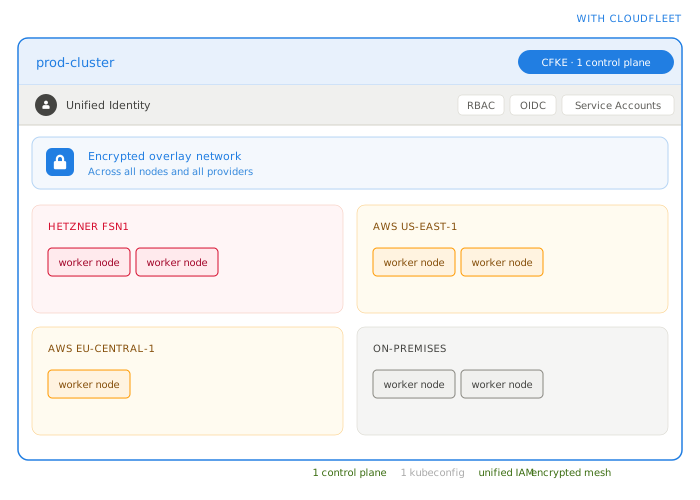
Fully managed Kubernetes, one cluster across clouds and on-premises
Control plane
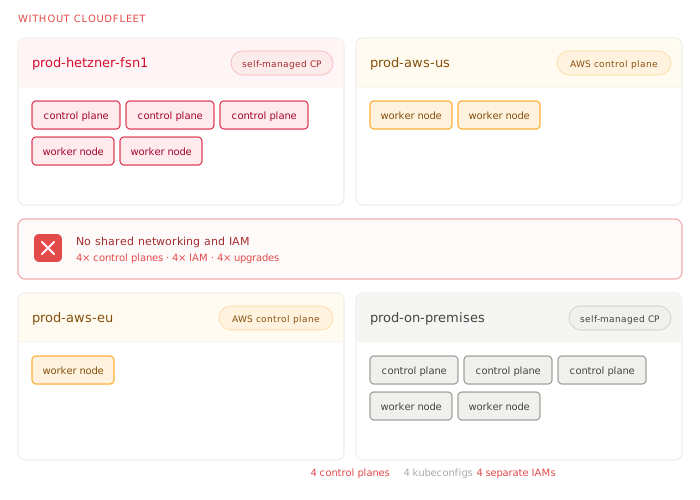
You run the Rancher server plus each RKE2 or K3s control plane
Managed by Cloudfleet, 99.95% SLA on Pro
Cluster model
One cluster per cloud or data center, connected through Rancher
One cluster that spans clouds and your own servers
Networking across locations
CNI and cross-cluster connectivity set up by your team
Encrypted WireGuard® overlay included
Cloud credentials
Static credentials configured and rotated per cluster
Workload Identity Federation, no long-lived keys
Pricing
Open source, Rancher Prime priced per node through SUSE sales
Published plans from $14/month (€12), $230 (€200) signup credit
Data sovereignty
Only if you host and operate the whole stack yourself
Managed, data and metadata stay in European jurisdiction
Support
Rancher Prime covers the Rancher software, not your clusters
Pro includes support for the whole cluster, 8-hour response SLA
Architecture
Your entire infrastructure footprint. One unified cluster.
Managed control plane
Cloudfleet is CNCF-conformant, allowing seamless migration of any conformant clusters while avoiding vendor lock-in.
Node autoprovisioning
Cloudfleet dynamically provisions compute capacity based on real-time demand.
On-premises tooling
Add on-premises nodes to your cluster with a single command and schedule pods across both on-premises and cloud nodes.
Global networking
Nodes securely connect via an encrypted network spanning multiple clouds and regions.
Why teams look for alternatives to Rancher
Rancher Kubernetes without the Rancher server
Rancher Kubernetes is a self-hosted management layer. You install the Rancher server, keep it highly available, upgrade it, and then operate every RKE2 or K3s cluster underneath it. Rancher gives you one place to look at many clusters, but each cluster still has its own control plane, networking, credentials, and upgrade cycle. Rancher Prime adds SUSE support for the Rancher software, not for the clusters you run with it.
Cloudfleet is a fully managed Rancher alternative. Instead of a management server on top of separate clusters, Cloudfleet runs one Kubernetes control plane that spans your clouds and your own servers. Cloudfleet operates the control plane, provisions cloud nodes, and connects every node over an encrypted network. Your team keeps standard Kubernetes APIs, kubectl, Helm, and GitOps.
No management plane to operate
With Rancher, the platform is one more system your team runs: the Rancher server, its database, its certificates, and its upgrades, on top of the clusters themselves. Cloudfleet has no user-operated infrastructure for the platform. Pro clusters come with a 99.95% control plane uptime SLA and an 8-hour support response time.
One cluster instead of a fleet of clusters
Rancher multi-cluster management connects separate clusters, one per cloud or data center, and you wire networking between them. A Cloudfleet cluster spans AWS, GCP, Azure, Hetzner, other providers, and on-premises servers at the same time. Nodes talk to each other over a WireGuard® overlay, so Pods reach Services across locations without VPNs or service mesh setup.
Keyless access to cloud APIs
Rancher clusters typically reach cloud provider APIs with static credentials that you configure and rotate per cluster. Cloudfleet supports Workload Identity Federation, so workloads access AWS, Google Cloud, and Azure APIs without long-lived keys stored in the cluster.
Published pricing
Rancher is open source, but production use means your own infrastructure, an operations team, and often a Rancher Prime subscription priced per node through SUSE sales. Cloudfleet publishes its prices. The Basic tier starts at $14/month (€12) with no cluster size limits. The Pro tier is $79/month (€69) and includes support.
European sovereignty, without running it yourself
With Rancher, keeping data under European jurisdiction means hosting and operating the whole stack yourself. Cloudfleet is a European company headquartered in Berlin. Your application data stays on the compute you choose, such as Hetzner, OVHcloud, Scaleway, Exoscale, or your own servers. Cluster metadata stays encrypted in the Frankfurt control plane region, keeping both data and metadata within European jurisdiction.
Your servers, any Linux distribution
Keep the hardware and the Linux distribution you run today. Bare metal, Proxmox VE, and VMware vSphere servers join the same cluster as your cloud nodes with a single command, and Cloudfleet takes over Kubernetes on every node. No RKE2 or K3s installs to maintain.
Migration support
Moving off Rancher? We cover the overlap period while you migrate
Most teams run Rancher and Cloudfleet side by side for a few weeks and move workloads one cluster at a time. Through the Migration Acceleration Program, Cloudfleet offers up to $10,000 in credits toward cluster management fees, training, and professional services, and Cloudfleet Kubernetes architects help you plan the cutover. Here is what moving from RKE2 or K3s clusters involves.
Cloudfleet runs CNCF-conformant Kubernetes, so manifests and Helm charts from RKE2 and K3s apply without changes. Point Argo CD or Flux at the new cluster, or replace Rancher Fleet GitRepos with Argo CD Applications or Flux Kustomizations that reference the same Git repositories.
Components bundled with K3s and RKE2
K3s ships Traefik, ServiceLB, and a local-path storage provisioner, and RKE2 ships its own ingress controller. On Cloudfleet, load balancers and persistent volumes are integrated with your cloud providers, and you choose any ingress controller or Gateway API implementation, including Traefik. No bundled components to maintain.
Rancher-specific resources
Rancher Projects, Rancher-managed RBAC, and Rancher Monitoring have no counterpart outside Rancher. Map Projects to namespaces with Kubernetes RBAC, and replace Rancher Monitoring with kube-prometheus-stack, which Rancher Monitoring is built on. Copy data on local volumes with a backup tool such as Velero.
Your on-premises servers
Servers that run RKE2 or K3s today join Cloudfleet with a single CLI command or Terraform, on the Linux distribution you already run. Cloudfleet takes over Kubernetes on the node, so your team never upgrades RKE2 or K3s again.
Get started
Switch from Rancher to Cloudfleet
Create a Kubernetes cluster
Start with $230 (€200) in credit when you sign up. The Basic plan starts at $14/month (€12) with no cluster size limits.
Most alternatives to Rancher, such as Red Hat OpenShift, swap one platform you operate for another. Cloudfleet is the fully managed alternative. It runs a single managed Kubernetes cluster across clouds and on-premises servers, so there is no management server and no per-cluster control plane to operate.
SUSE sells Rancher Prime as a subscription priced by the number of managed nodes, and quotes come from SUSE or its partners rather than a public price list. You also pay for the infrastructure that runs the Rancher server and the time your team spends operating it. Cloudfleet publishes its pricing. The Basic tier starts at $14/month (€12) with no cluster size limits, the Pro tier is $79/month (€69) with support and a 99.95% SLA, and every new account gets $230 (€200) in credit.
No. Cloudfleet’s control plane is fully managed and requires no user-operated infrastructure. There is no server to install, upgrade, back up, or keep highly available. You work with your clusters through the standard Kubernetes API, the Cloudfleet CLI, Terraform, or the Cloudfleet Console.
Yes. Cloudfleet runs its own CNCF-conformant Kubernetes distribution, so workloads from RKE2 and K3s move with the same manifests, Helm charts, and GitOps repositories. Cloudfleet Kubernetes architects map Rancher-specific resources such as Projects, Rancher Monitoring, and ServiceLB for you, and your on-premises servers join the new cluster with one command.
Rancher is a multi-cluster manager from SUSE that runs on top of RKE2, K3s, or other Kubernetes distributions. Red Hat OpenShift is an opinionated Kubernetes distribution with its own developer platform and per-core subscriptions. In both cases your team operates the control planes. Cloudfleet is managed Kubernetes: it runs the control plane for you and keeps the standard Kubernetes APIs, with no Rancher or OpenShift-specific abstractions.
Many teams use Rancher multi-cluster management because they run one cluster per location. A Cloudfleet cluster spans locations, so you often need fewer clusters. For GitOps, Cloudfleet works with standard Helm repositories, Argo CD, and Flux without proprietary extensions, so Rancher Fleet GitRepos map to Argo CD Applications or Flux resources.
Cloudfleet seamlessly extends your cluster anywhere, turning any hardware - even in your office or home - into a modern enterprise cluster.
Jules Huls
Information Security Expert
Using Cloudfleet together with Hetzner allowed us to bring up a managed Kubernetes cluster just as quick as with any US-based hyper-scaler, but with the benefit of being EU hosted which is very valuable in today's times.
Martin Schulze
CEO & Founder
By combining our standardized configurations with the powerful automation features of the Cloudfleet platform, we've built a development workflow that is fast, secure, and incredibly efficient.
Onur Solmaz
VP of Engineering and Research
Perfect balance between flexibility and managed service - and the support is outstanding.
Daniel Costa
Sales Engineer
We deploy to customer infrastructure without changing how we build or manage Kubernetes.
Julian Becker
Principal DevOps Engineer
It is easy to build a multi-cloud setup without getting locked into any single provider.
Carlos Mendes
Infrastructure Architect
It is easy to build a multi-cloud setup without vendor lock-in.
Luca Meyer
Principal DevOps Engineer
Cloudfleet lets us scale our game servers across multiple providers - reliably and affordably.
Max Keller
Senior DevOps Engineer
Cloudfleet not only cut our infrastructure costs - it saved us hours of work by taking cluster management off our plate.
Richard Callahan
Engineering Manager
Why Cloudfleet
Designed for modern cloud operations.
Hybrid-cloud by design
Run Kubernetes consistently across public cloud, private infrastructure, and on-prem environments, with a single control plane and unified operational model.
Operational simplicity
Operate, scale, and migrate Kubernetes clusters across environments using a consistent, opinionated platform that reduces operational overhead.
Predictable costs
Transparent pricing and infrastructure control help you avoid hyperscaler lock-in, hidden fees, and unexpected cost growth as your workloads scale.
No vendor lock-in
Retain full portability of your clusters, workloads, and tooling by running standard Kubernetes without proprietary extensions or forced dependencies.
Production-grade support
Designed for production workloads, with operational tooling, escalation paths, and support processes built to meet enterprise reliability requirements.
Enterprise-ready security
Secure by default, with isolation, encryption, and access controls designed to meet the requirements of regulated and security-conscious organizations.
Try Cloudfleet with €200 in credit
Create a managed Kubernetes cluster in minutes. Every new account gets €200 in credit, so you can explore the full platform with no charge until it's used or expires.